
Fayetteville Criminal Conspiracy Lawyer
Experienced Criminal Conspiracy Attorney in Fayetteville, NC
Being charged with the crime of conspiracy with another individual to commit a crime can put your freedom and future on the line. The effects can still happen, even if the crime you are accused of did not come to fruition. A skilled Fayetteville criminal conspiracy lawyer can evaluate the details of your situation and explain the legal options that you have.
Criminal conspiracy charges can raise complex issues regarding agreements, intent, and each individual’s alleged role. The W. James Payne Law Firm has experience helping people accused of serious crimes navigate the criminal justice system and assert their rights.
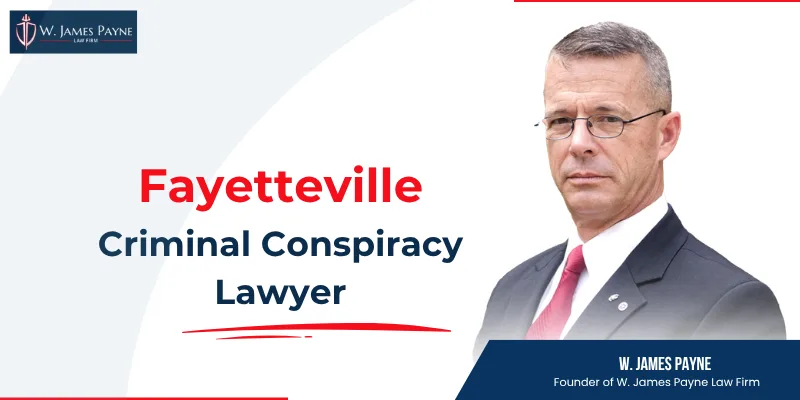
Hire a Criminal Conspiracy Lawyer
W. James Payne Law Firm’s criminal defense practice is built upon over 40 years of experience and thousands of cases defended. W. James Payne has been practicing law since 1984. In addition to being a retired Colonel of the U.S. Marine Corps Reserve, Payne spent five years as a military judge.
At W. James Payne Law Firm, we pride ourselves on zealous advocacy, meticulous case management, and honest, clear communication. We leave no stone unturned in pursuit of every available option for defending our clients’ life, liberty, and property.
How North Carolina Law Defines Criminal Conspiracy
In North Carolina, a criminal conspiracy is generally an agreement by two or more people to commit an unlawful act or to do a lawful act unlawfully. Prosecutors are required to prove the existence of an agreement and the intent that the agreement be performed. The agreement need not be formal or in writing.
Unlike the law in some states, North Carolina generally does not require a prosecutor to prove that a conspirator took an overt act in furtherance of the agreement. The alleged agreement itself may be the basis of the conspiracy offense where the other required elements are met.
When an Agreement Can Lead to a Conspiracy Charge
An alleged conspiracy doesn’t always require prosecutors to produce a signed or otherwise documented statement of agreement. Rather, the context of the accused parties’ actions and discussions may become relevant evidence, including:
- Texts
- Call logs
- Witness testimony
- Financial records
- Security camera footage
These could all potentially be used to make the case that people were acting in concert toward a criminal end.
Knowing, talking to, or being around someone accused of criminal behavior is not, by itself, sufficient to find a conspiracy. An attorney can review the evidence in context and question any inferences drawn as to what a defendant intended or agreed to.
Penalties for Criminal Conspiracy in North Carolina
North Carolina General Statutes § 14-2.4 generally classifies a conspiracy charge based on the classification of the offense that the person conspired to commit. Conspiracy to commit a felony is generally classified as one felony class lower than the targeted offense. The statute sets forth specific rules for certain felony classes.
Conspiracy to commit a Class A or Class B1 felony is a Class B2 felony, and conspiracy to commit a Class B2 felony is a Class C felony. Conspiracy to commit a Class I felony is a Class 1 misdemeanor. The statute also sets forth separate classification rules for conspiracies to commit misdemeanors.
Defenses Against Criminal Conspiracy Allegations
A defense to a criminal conspiracy charge can challenge the prosecutor’s theory of the crime. The defense may, based on the evidence, dispute one or more elements. For example, the defense can:
- Contest the existence of an agreement.
- Argue against the defendant’s state of criminal intent.
- Determine whether the defendant’s actions demonstrate participation in the plan.
In North Carolina, where conspiracy law prioritizes the existence of an agreement, a defense can make the case that the evidence doesn’t sufficiently show a shared intent to commit a crime.
Association, or a relationship between individuals, is insufficient to itself support a conspiracy. The facts and circumstances of the case must support the existence of the alleged agreement and not merely suspicion.
FAQs
Can I Be Charged With Conspiracy if I Did Not Know Everyone Involved?
You can be charged with conspiracy if you did not know everyone involved. The defendant does not have to know every other individual involved in the illegal activity. Instead, the focus is on the prosecution’s evidence related to that defendant’s own involvement and criminal intent.
In a case with many co-conspirators, a lawyer can help investigate whether the evidence links the defendant to the specific conspiracy charged rather than merely connecting that individual to others who are also under investigation.
Can I Face Both State and Federal Conspiracy Charges?
Yes, you can face both state and federal conspiracy charges. The underlying conduct may be alleged to violate state law, federal law, or both. Federal jurisdiction can arise when the alleged conduct implicates a federal criminal statute or otherwise falls within federal jurisdiction.
Federal agencies may get involved if the scheme violated federal criminal laws. In fiscal year 2025, the U.S. Sentencing Commission received information for 66,662 federal felonies and Class A misdemeanor sentencing cases.
Where Are Felony Conspiracy Cases Handled in Fayetteville?
Felony conspiracy charges filed in Fayetteville may proceed in the Cumberland County Superior Court. Pursuant to North Carolina law, the superior court normally has original jurisdiction over felony criminal cases.
However, the district court may conduct certain preliminary proceedings and, under certain conditions, also may accept guilty or no-contest pleas to certain felony charges. Which court handles a particular stage of a conspiracy case depends on the classification of the charge and the procedural posture of the case.
How Common Are Serious Criminal Cases in Federal Court?
Serious criminal cases in federal court are not as rare as many think. Federal criminal prosecutions include a wide range of offenses. The U.S. Sentencing Commission reported 66,662 cases in fiscal year 2025, of which 13,926 involved an offense with a statutory mandatory minimum penalty.
A mandatory minimum does not automatically apply just because an individual is charged with conspiracy. Whether one applies depends on the offense and the federal statute under which the offense is prosecuted.
Contact a Fayetteville Criminal Conspiracy Lawyer
The weight of a conspiracy charge can make it difficult to know where you stand regarding your freedom, reputation, and future. W. James Payne Law Firm has defended people charged with serious criminal offenses in Fayetteville and throughout North Carolina. Schedule a consultation today to hire a criminal conspiracy lawyer.
Fayetteville, NC Criminal Conspiracy Resources:
Request A Consultation
Fields Marked With An “ * ” Are Required
"*" indicates required fields


4434 Main Street
Shallotte, NC 28470
(910) 754-9411
1213 Culbreth Drive
Wilmington, NC 28405
(910) 754-9411
476 Joe Tweed Road
Marshall, NC 28753
(910) 754-9411
© 2026, W.James Payne Law Firm • All Rights Reserved •
Digital Marketing By 
*Images are obtained under license from Canva and other third-party stock image providers, with attribution included where required.